
By Christian Martin
A landmark Stanford audit of a real-world hiring algorithm, covering 3.4 million people, 4 million applications, and 150 employers, found systematic discrimination against Black and Asian applicants, and a new kind of digital redlining when employers share a vendor.
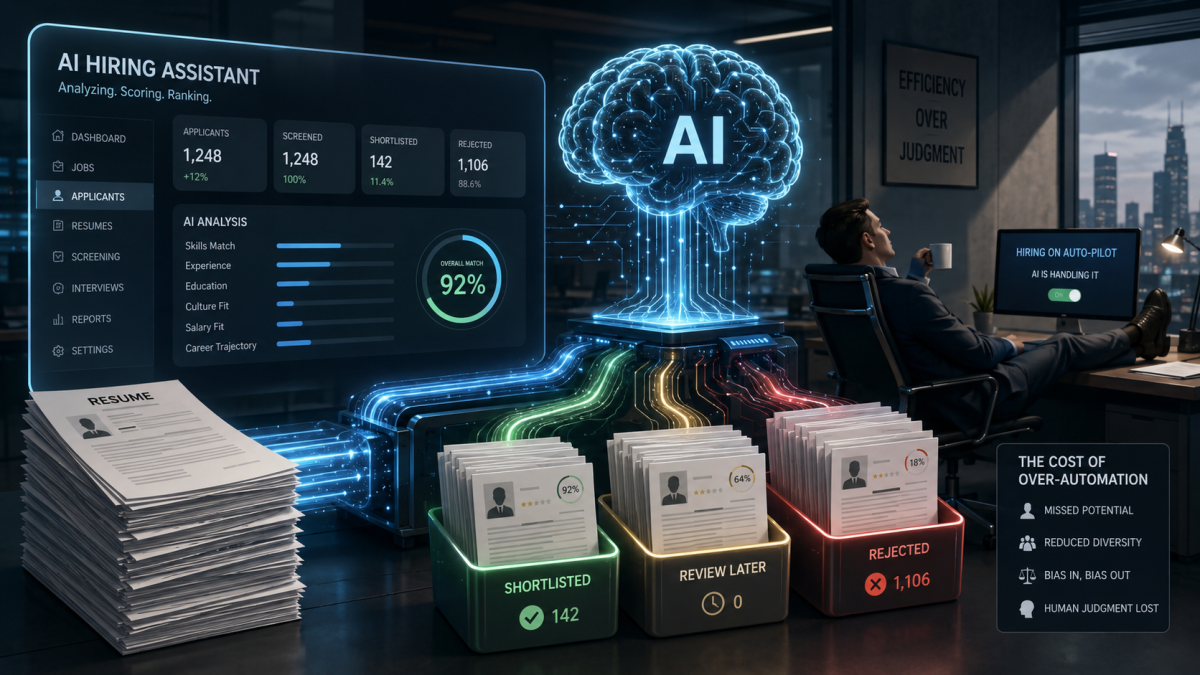
A landmark study out of Stanford University has just cracked open the black box of AI-driven hiring, and what spills out should alarm every worker, every policymaker, and every executive who has ever mouthed the words "diversity and inclusion." The research, the first large-scale audit of a real-world algorithmic screening tool, followed 3.4 million people submitting 4 million applications across 150 employers. Its central finding is as damning as it is precise: the AI system systematically discriminated against Black and Asian applicants, and when many companies rely on the same vendor, a new form of digital redlining emerges, locking entire groups out of whole sectors of the economy. The study is a mirror held up to a job market that has quietly outsourced its moral judgment to machines. And it raises an uncomfortable question that no one in Silicon Valley wants to answer: why, with all their wealth and human capital, are the world’s most powerful technology companies too lazy to read résumés themselves?
Let us sit with the numbers first. Using the Equal Employment Opportunity Commission’s four-fifths rule, the standard by which federal regulators flag potential discrimination, the Stanford team found that 26 percent of Black applicants and 15 percent of Asian applicants applied to positions where the AI system’s recommendations exhibited significant adverse impact against their racial group. In plain terms, the algorithm was less likely to advance a Black or Asian candidate than the most favored group, usually white applicants, across a substantial share of jobs. Had the machine recommended Black and Asian candidates at the same rate as it recommended the top group, an additional 40,000 applications from those communities would have moved forward. That is not a rounding error. It is a gate slammed shut on tens of thousands of careers.
Even more pernicious is what the researchers call "algorithmic monoculture." Because 90 percent of large U.S. employers now use AI screening tools, and most rely on a handful of third-party vendors, the same flawed logic is being applied everywhere at once. The study reveals that applicants who submitted multiple applications to employers using the same vendor were far more likely to be rejected from every single job than if those companies had decided independently. Ten percent of candidates who applied to four such positions were shut out completely. One algorithm’s biases, in other words, do not remain politely contained within one company’s hiring portal; they compound into a systemic wall that entire demographic groups cannot scale.
Race is not the only vector of discrimination being baked into these systems, and here the Stanford study, while essential, is only the latest entry in a rapidly thickening dossier. Age bias, long the most socially acceptable prejudice in the American workplace, is being automated with terrifying efficiency. A 2023 hearing held by the EEOC on algorithmic fairness highlighted how AI hiring tools can infer age from graduation dates, from the length of a work history, even from the formatting conventions of a résumé, and then quietly penalize older candidates. The AARP has found that 78 percent of workers over 50 have either seen or experienced age discrimination personally. When that bias is coded into a machine-learning model trained on historical hiring data, the effect is to turbocharge a preexisting injustice, laundering it through the appearance of mathematical neutrality. A 2024 Bloomberg investigation documented cases where experienced professionals were repeatedly rejected within hours of applying, their applications never seen by a human being, while a recent lawsuit against the HR software giant Workday alleges that its screening tools discriminate on the basis of both race and age. The pattern is unmistakable: an entire generation of workers, disproportionately women and people of color who already faced structural barriers, is being quietly erased.
Why, then, does Big Tech persist? The standard defense is one of volume. The avalanche of applications, we are told, is simply too vast for human beings to process. Companies point to the fact that entry-level openings now receive nearly three times as many applications as they did in 2022. But this argument collapses under the slightest scrutiny. The same firms pleading overwhelmed HR departments are some of the most resource-rich institutions in the history of capitalism. A company like Amazon, which received over a million applications for corporate roles in a single recent year, also employs well over a million people and generates hundreds of billions in revenue. To suggest that it cannot afford to build a properly staffed, thoughtfully designed, human-centric evaluation process is not an engineering claim; it is a declaration of priorities.
The truth is that AI screening tools are not being deployed because they are necessary. They are being deployed because they are cheaper, faster, and allow organizations to abdicate the difficult intellectual and moral work of defining merit in a just way. Real hiring is messy. It demands that managers wrestle with non-linear career paths, with the value of life experience versus a crisp credential, with the difference between a candidate who needs a little development and one who is fundamentally unsuited. Offloading that judgment to a black-box algorithm that reduces a human being to a set of keyword matches and statistical correlations is not efficiency; it is laziness dressed in the language of innovation. It is a choice to invest in a vendor contract rather than in the rigorous training of hiring panels, the expansion of recruitment teams, or the slower but fairer processes that genuinely equitable selection requires.
There is a deeper intellectual bankruptcy at work as well. The Stanford paper demonstrates that when you pool all the AI vendor’s recommendations together, the system appears unbiased. The aggregate hides the job-by-job discrimination. This is a statistical sleight of hand that the technology industry has perfected: using large-scale averaging to paper over the granular realities of harm. It is the same logic that allows a platform to boast about overall representation numbers while Black and older workers are systematically excluded from the most upwardly mobile roles. Big Tech knows this. Its own research scientists have published papers on algorithmic fairness for years. Amazon famously scrapped an internal recruiting tool in 2018 after discovering it penalized résumés that contained the word "women’s." Yet the industry as a whole has moved in the opposite direction, embedding third-party screening tools deeper into the hiring pipeline, often with less transparency than ever.
The path forward requires shedding the myth that these systems are inevitable. Independent audits like the Stanford study must become routine, mandated, and publicly accessible. The EEOC has begun to signal a more assertive posture, but regulatory frameworks still treat algorithmic discrimination as a novel problem rather than what it is: the oldest forms of exclusion, digitized and scaled. Employers with the resources to do so (and make no mistake, every major tech firm has the resources) should be required to demonstrate that human judgment plays a meaningful role in every hiring decision, and that automated filters are merely assistive, not dispositive.
Most fundamentally, we need to reassert a simple principle: hiring is a human act of recognition. It is seeing potential in another person. No machine, no matter how elegantly trained on past data, can perform that act with justice, because justice is not a pattern but a commitment. When Stanford’s researchers conclude that the value of independent research is the key lesson of their work, they are being diplomatic. The real lesson is that in our rush to delegate judgment to software, we have created a sprawling, unaccountable system that is deepening inequality by the hour. The companies that dominate this landscape have the manpower, the money, and the moral duty to dismantle that system. They choose not to. That is no longer a bug. It is the feature, and we should all be furious.
Source: Stanford Institute for Human-Centered AI (HAI), "AI Hiring Tools Can Yield Racial Bias and Systemic Rejection."